Ice Fish Slot Strategy Guide (2026 Edition) – Smart Play for US Players
Ice Fish is not a traditional five-reel slot, and that is exactly why strategy discussions around it are different. While the game blends live game show mechanics with RNG-driven outcomes, experienced players understand that structured decision-making, bankroll planning and coverage balance can significantly influence session stability.
This guide for icefishing-demo.net focuses entirely on strategy for Ice Fish. It avoids repeating general gameplay explanations and instead concentrates on session structure, probability awareness, coverage allocation and disciplined execution — all tailored for US-based players.


| Feature | Details |
|---|---|
| Game Name | Ice Fish |
| Provider | Evolution |
| Release Year | 2025 |
| Game Format | Live Game Show + RNG |
| Wheel Segments | 53 |
| RTP Range | 94.55% – 97.10% (depending on bet type) |
| Volatility | Medium to High |
| Minimum Bet | $0.10 |
| Maximum Bet | Up to $1,000 (varies by table) |
| Maximum Multiplier | 5,000× |
| Bonus Types | Lil’ Blues, Big Oranges, Huge Reds |
| Average Round Time | 45–60 seconds |
| Mobile Compatibility | Fully optimized for mobile & desktop |
| Regulation | Certified RNG, independent auditing |

Understanding What “Strategy” Means in Ice Fish
Before diving into actionable approaches, it is important to clarify one thing:
Ice Fish is powered by certified RNG and live mechanics. No strategy can change the mathematical RTP or guarantee outcomes.
However, strategy does influence:
- Session volatility
- Bankroll longevity
- Exposure to bonus events
- Emotional control
- Risk distribution
In other words, strategy is not about predicting the wheel. It is about controlling your decisions.

Bankroll Structuring – The Foundation of Any Approach
Most mistakes happen before the first spin.
Recommended Bankroll Allocation (US Market)
For structured sessions:
- Conservative play: 250–300× base bet
- Balanced play: 200× base bet
- Aggressive play: 120–150× base bet
Example:
If your average bet allocation per round equals $2 total coverage, you should ideally sit with $400–$600 for balanced play.
This does not mean you must deposit that much. It means you adjust your bet size to your bankroll.
Understanding Coverage Strategy
Ice Fish allows players to distribute bets across multiple segments:
- Leaf 1
- Leaf 2
- Lil’ Blues
- Big Oranges
- Huge Reds
- All Bonuses
The way you split coverage defines your volatility.
Conservative Coverage Model
- 50% Leaf 1
- 20% Leaf 2
- 30% All Bonuses
Purpose:
- Frequent smaller wins
- Steadier balance curve
- Reduced psychological pressure
This model works best for extended sessions (45–60 minutes).
Balanced Coverage Model (Most Popular in the US)
- 40% Leaf 1 + Leaf 2 combined
- 30% All Bonuses
- 15% Lil’ Blues
- 15% Big Oranges
Purpose:
- Maintain RTP exposure through Leaf
- Keep bonus upside
- Allow mid-tier bonus hits
This model performs well for 30–45 minute sessions.
High-Volatility Model
- 40% Huge Reds
- 40% All Bonuses
- 20% Big Oranges
Purpose:
- Chase high multipliers
- Accept longer dry streaks
- Target explosive sessions
This strategy requires strong bankroll discipline.

Session Timing Strategy
Ice Fish rounds are fast — approximately 45–60 seconds.
That creates a hidden risk: overexposure.
Recommended Session Structure
- 10-minute warm-up
- 25-minute main play
- 5-minute evaluation break
Maximum total session time: 60 minutes.
Why?
Fatigue increases impulsive coverage adjustments.
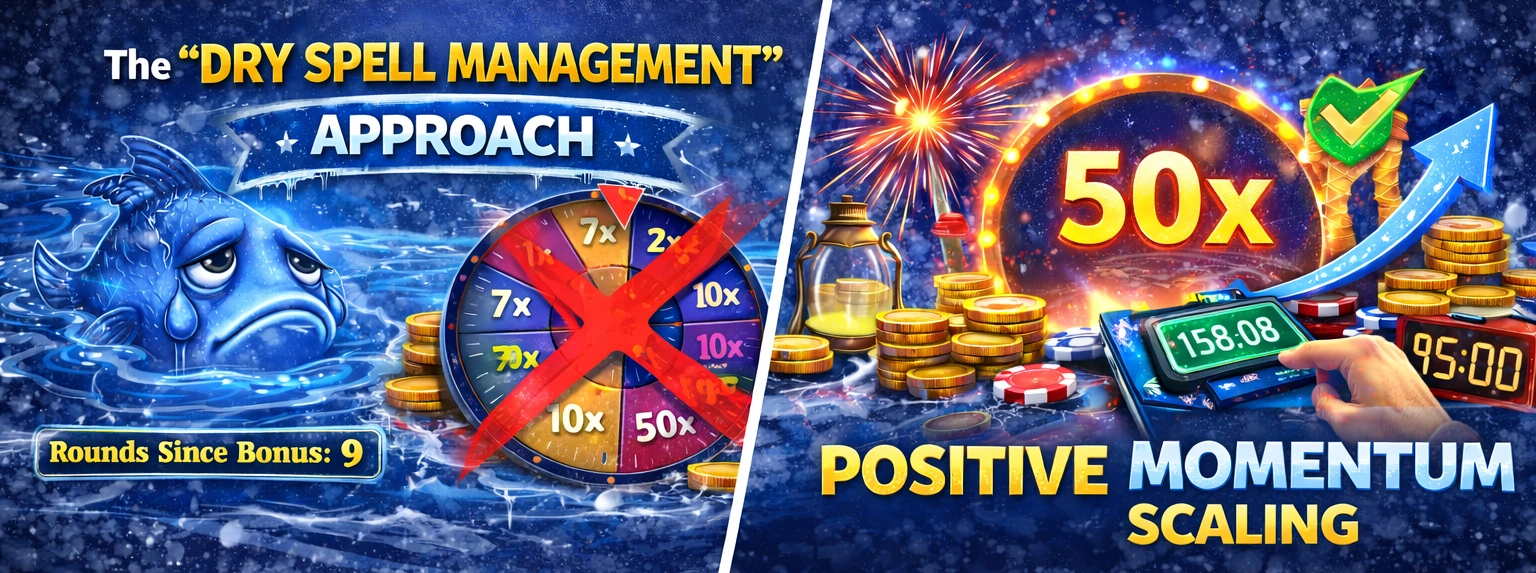
The “Dry Spell Management” Approach
One of the most common mistakes is reacting emotionally to bonus droughts.
Statistically, bonus frequency averages around 18–24%.
That means 1 bonus roughly every 4–6 rounds — but clustering happens.
You may see:
- 3 bonuses in 5 rounds
- 0 bonuses in 12 rounds
Smart Response Model
After 8 non-bonus rounds:
Option A (Balanced Strategy)
Increase total stake by 20% for 3 rounds only.
Option B (Conservative Strategy)
Do nothing. Maintain structure.
Option C (Advanced)
Shift 10% coverage from Leaf to All Bonuses temporarily.
Never double repeatedly. Avoid Martingale logic.
Positive Momentum Scaling
Advanced players use structured scaling.
If you hit:
- 50×–100× bonus → reduce total stake by 20%
- 150×+ bonus → withdraw partial profit or lock session
This protects profit during hot streaks.
The goal is not maximizing one spin — it is preserving winning sessions.
Risk Segmentation by Player Profile
Low-Risk Player
- Focus: Leaf segments
- Smaller bonus allocation
- Longer sessions
- Lower emotional variance
Medium-Risk Player
- Balanced split
- Controlled adjustments
- 30–45 minute sessions
High-Risk Player
- Huge Reds focus
- Short 20–30 minute bursts
- Strict stop-loss at 40%
Stop-Loss and Stop-Win Systems
Stop-Loss
- Conservative: -25%
- Balanced: -35%
- Aggressive: -40%
Stop-Win
- +50% session gain (minimum)
- +80% strong exit point
Leaving after a strong win is statistically wiser than extending.

Using Demo Mode for Strategy Testing
Icefishing-demo.net exists for a reason.
Demo mode allows:
- 200–500 simulated rounds
- Volatility tracking
- Coverage experimentation
- Emotional response testing
What to track:
- Rounds until first bonus
- Longest dry streak
- Largest multiplier
- Balance fluctuation curve
Keep simple notes. Patterns won’t predict future outcomes, but they improve decision discipline.
Psychological Strategy
Ice Fish has a calm aesthetic that can mask volatility.
Key psychological checkpoints:
- Do not increase stake due to boredom.
- Avoid chasing Huge Reds exclusively.
- Take a 5-minute break after any 200×+ win.
- Avoid playing under stress.
Discipline beats aggression long term.
Multi-Coverage Probability Awareness
Each bonus type has different frequency behavior:
- Lil’ Blues = Most frequent
- Big Oranges = Moderate
- Huge Reds = Rare but highest ceiling
Diversification reduces risk.
Concentration increases variance.
There is no universally best choice — only best choice for your bankroll size.
Advanced Tracking Strategy
Serious players track:
- Total rounds per session
- Bonus frequency
- Multiplier distribution
- Net session result
After 10 demo sessions, you gain a realistic volatility expectation.
Not predictive — but informative.
What NOT To Do
Avoid:
- Martingale on bonuses
- Increasing stakes after every loss
- Removing Leaf coverage entirely
- Playing longer than 60 minutes
- Ignoring bankroll percentage rules
The game is designed for entertainment, not system exploitation.
Strategy Based on Session Goals
Goal: Entertainment
Use balanced coverage.
Ignore micro-optimizations.
Goal: Bonus Hunting
Short sessions.
Higher Huge Reds allocation.
Strict stop-loss.
Goal: Steady Grinding
Heavy Leaf exposure.
Lower bonus variance.
Longer controlled sessions.
The Reality of RTP and Strategy
RTP range: 94.55%–97.10% depending on coverage.
Leaf segments typically provide the higher RTP structure.
Bonus-heavy coverage reduces effective RTP but increases upside.
Understanding this trade-off is critical.
Responsible Play Reminder
Ice Fish is designed for adult entertainment. Always play within your limits. Use deposit limits and cooling-off tools when available.
If gambling stops being fun, step away.

Final Strategic Framework
For most US players, the most sustainable approach is:
- 200× bankroll minimum
- 40% Leaf coverage
- 30% All Bonuses
- 15% Lil’ Blues
- 15% Big Oranges
- Stop-loss at -35%
- Stop-win at +60%
- Maximum 60-minute session
Ice Fish rewards structured patience more than impulsive aggression.
Conclusion
There is no magic formula to beat Ice Fish. But there is a disciplined way to approach it.
Strategy in this game means:
- Controlling exposure
- Managing volatility
- Protecting bankroll
- Structuring sessions
- Avoiding emotional decisions
Use demo mode extensively. Test coverage. Track behavior. Build structure before risking real money.
Smart play does not guarantee wins — but it dramatically improves long-term session control.
That is the real edge.
FAQ – Ice Fish Strategy & Gameplay (USA)
Is there a winning strategy for Ice Fish?
There is no guaranteed winning strategy because the game uses certified RNG mechanics. However, structured bankroll management and coverage planning can improve session control.
Which betting option has the highest RTP?
Leaf segments typically provide the highest RTP structure. Bonus-focused betting increases volatility and potential payout but slightly lowers RTP.
How much bankroll should I have before playing?
A recommended range is 200–300× your base bet for balanced or conservative strategy sessions.
Is it better to focus only on Huge Reds?
No. Huge Reds offer the highest potential multiplier but appear less frequently. Balanced coverage reduces volatility risk.
Does demo mode reflect real-money gameplay?
Yes. Demo mode runs on the same mechanics and RTP model, allowing accurate volatility testing without financial risk.
How long should a session last?
Most disciplined players limit sessions to 30–60 minutes to avoid fatigue and impulsive decision-making.